Why Embossed Leggings Snag on Gym Equipment When Smooth Ones Do Not
Quick Answer: Embossed leggings snag more than smooth ones because the raised pattern stands above the fabric plane, so any rough edge catches the peak of the texture instead of sliding across a flat surface. The three worst offenders are velcro on gloves and lifting straps, worn bench and seat upholstery, and the knurled or chipped edges on older machines. A snag is a pulled loop, not a hole - do not cut it, and it is usually recoverable in under two minutes.
You have worn smooth leggings on the same machines for two years without a single mark. Two weeks into a textured pair, there is a pulled thread on the outer thigh.
It is not that the new pair is badly made. Texture changes the geometry of the surface, and geometry is the entire story here.
Once you know which three things cause almost all of it, the fix is mostly about where you sit and what you strap to your hands.

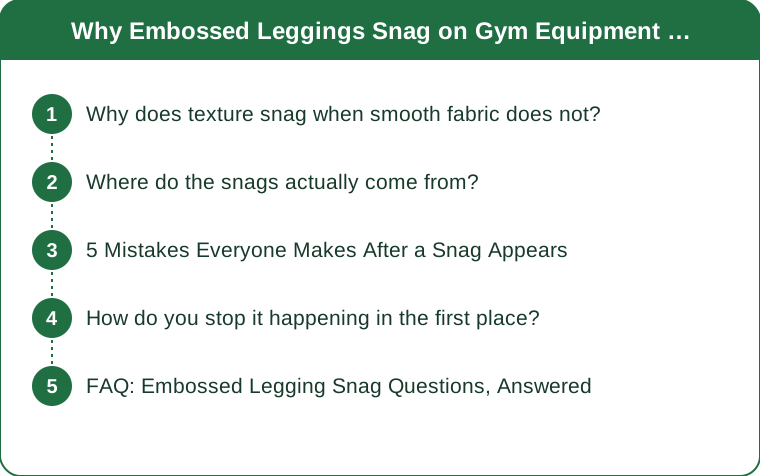
Why does texture snag when smooth fabric does not?
Because a raised pattern gives rough edges something to catch on, and a flat knit does not.
On smooth leggings, the yarns sit in one plane. A rough edge - a splintered bench, a velcro hook, a burr on a machine - drags across the top of that plane and mostly slides.
On an embossed or textured fabric, the pattern is created by raising sections of the knit above the base surface. Those raised sections are the first thing any rough edge meets, and they are meeting it side-on rather than flat-on.
There is a second factor that matters just as much: the raised sections often sit slightly looser than the flat areas. That is how the texture is formed - more yarn in the same space, pushed upward. A looser loop is easier to lift out of position than a tight one.
So the two things stack. The texture presents itself first, and what is presented is the part of the knit with the most slack in it.
This is not a quality problem. A well-made embossed legging and a poorly-made one both do this, because both are textured. What quality changes is what happens after a snag - a dense, well-finished knit tends to hold its neighbours in place, while a loose one lets the pull travel.
Where do the snags actually come from?
Three sources account for the large majority, and they are all avoidable once identified.
Velcro is number one, by a wide margin. Lifting gloves, wrist wraps, some knee sleeves, gym bag closures, and the strap ends on weight belts. Velcro hooks are literally designed to grab raised loops of fabric - which is a precise description of what an embossed knit is. The most common snag pattern is a cluster of small pulls on the outer thigh, which is exactly where a hand with a wrapped wrist rests between sets.
Worn upholstery is number two. Bench seats, rowing machine seats, and the backrests on selectorised machines take years of abrasion. Once the vinyl cracks, the edges of those cracks are stiff and sharp. You will never notice them through smooth fabric. A textured knit finds them immediately, usually on the back of the thigh or the glute.
Machine edges are number three. The knurled grip on a bar, a chipped powder-coated frame, the seat adjustment pin, and the edge of a leg press platform. Any place where the coating has come away leaves a rough metal edge.
A fourth, quieter one: your own washing machine. A zip left open in the same load, a bra hook, or the drum’s own paddle edges. Textured activewear should go in a mesh bag more than smooth activewear should, and this is the reason.
And one worth knowing about now specifically: as the weather turns and you start layering, jacket zips and toggle ends move up the list. A half-zip pullover with an unprotected zip garage sits right where you bend to tie a shoe.

5 Mistakes Everyone Makes After a Snag Appears
Mistake 1: Cutting the pulled loop. This is the instinct and it is the one thing that turns a recoverable snag into permanent damage. The pulled thread is still connected to the knit on both sides. Cut it and you have created two loose ends and a hole that will grow. Never cut it.
Mistake 2: Pulling it straight out to see how bad it is. Every millimetre you pull is a millimetre of yarn taken from the surrounding fabric, which puckers the area around it. The snag gets longer and the fabric next to it gets tighter.
Mistake 3: Trying to smooth it flat from the outside. Rubbing the surface pushes the loop around but does not put the yarn back where it came from. It usually spreads the disturbance sideways.
Mistake 4: Assuming it means the leggings are finished. A single snag is cosmetic. It affects nothing about the compression, the opacity or the lifespan, provided you do not cut it. Plenty of people retire a good pair over one pull.
Mistake 5: Washing them normally straight afterwards. Agitation is what turns one loose loop into a run. Get the loop dealt with before the next wash, and put them in a mesh bag when you do.
What to do instead, in about ninety seconds: turn the leggings inside out and find the snag from the reverse. Use a blunt needle, a crochet hook or even a bobby pin to push the loop through to the inside. Then, working outward from the snag, gently stretch the fabric in four directions - up, down, left, right. This redistributes the borrowed yarn back into the surrounding knit. In most cases the surface texture closes over it and it disappears entirely.
How do you stop it happening in the first place?
The prevention list is short because the causes are concentrated.
Close your velcro before it goes near your leg. Wraps and gloves have a closed position for exactly this reason. The habit is to leave them half-open between sets, resting on your thigh. Fasten them back onto themselves instead - this single change removes most snags for most people.
Put a towel on any bench you sit on. You should be doing this anyway, and it solves the worn-upholstery problem completely. It also means you stop having to inspect seats.
Run a hand along a machine seat before you use it. Two seconds. You are feeling for cracked vinyl and exposed staples, both of which are common on the machines nobody replaces.
Wear your textured pairs for the sessions that suit them. Running, walking, yoga, classes and cardio machines involve almost no contact with rough surfaces. Heavy strength work with straps, benches and knurled bars is where the risk sits. If you own both smooth and textured pairs, matching the pair to the session is easier than changing the session.
Mesh bag in the wash, always, and zips closed on everything else in the load. The wash is the source people underestimate because the damage does not appear until later.
And check your own gear. The most persistent snag source many people have is a single item they own - a bag strap with an exposed rivet, a watch with a rough lug, a ring worn stone-inward. If snags keep appearing in the same place, the cause is something you bring with you rather than something at the gym.
FAQ: Embossed Legging Snag Questions, Answered
Does a snag mean the fabric was cheap?
No. Snagging is a function of the surface geometry, and every embossed knit has that geometry. Fabric quality shows up in what happens next - a dense, well-finished knit resists the pull travelling, and the surrounding texture usually closes back over a repaired snag so completely that you cannot find it. A loose knit lets one pull turn into a run.
Can I actually fix a snag at home?
Yes, in most cases, and it takes under two minutes. Turn the leggings inside out, push the pulled loop through to the wrong side with a blunt needle or crochet hook, then stretch the fabric gently in all four directions around the spot to redistribute the yarn. The critical rule is that you never cut the loop - it is still load-bearing thread, and cutting it creates the hole you were trying to avoid.
Are some textures worse than others?
Yes. Higher relief means more exposure - a deep waffle or a pronounced ribbed emboss catches more than a subtle crinkle or a fine pebble texture. Directional patterns also matter: a texture with long raised ridges gives a rough edge something to run along, while a broken or scattered pattern tends to catch a single point and stop. If snagging has been a recurring problem for you, choosing a lower-relief texture makes a measurable difference.
TL;DR:
- Texture snags because the raised pattern sits above the fabric plane and is looser than the flat sections.
- Velcro, worn bench upholstery, and chipped machine edges cause the large majority of snags.
- Never cut a pulled loop. Push it through to the inside and stretch the fabric around it in four directions.
- Fasten wraps and gloves closed, towel on every bench, mesh bag in the wash.
- If snags keep appearing in the same spot, the cause is usually something you own rather than the gym.
One pull is not the end of a good pair. It is a two-minute repair and a small change to where you rest your hands between sets.
See It in Motion
Seen here: High Waist 8” Yoga Shorts — shop similar styles on bubblelime.com
Keep Reading
This article is for general informational and styling purposes only. Fit, sizing, and product availability may vary.