Why Embossed Leggings Look Different in Every Photo (And How to Buy Around It)
Quick Answer: Embossed leggings look different under different light because the pattern isn’t printed — it’s pressed into the fabric, so it relies on shadow and sheen to read. Overhead gym lighting flattens the texture into a faint print, natural side-light exaggerates the raised ridges into deep contrast, and camera flash bounces off the embossed peaks and can wash the pattern out almost entirely. To judge a pattern before buying, look for a product photo with a raking side light (not a flat studio shot) and check the fabric spec for “heat-pressed” or “embossed knit” rather than “printed.”
You order the snakeskin leggings because the product photo shows deep, dimensional scales — the kind that look expensive. They arrive, you put them on under your bathroom’s overhead light, and the pattern reads almost flat, like a subtle shadow instead of texture. Nothing is wrong with the leggings. You just met them under the wrong light for the first time.
What Actually Causes Embossed Patterns to Change Appearance?
An embossed legging isn’t dyed with a pattern — it’s a solid-color knit that’s been run through a heated press with an engraved roller, which physically compresses the fibers in the pattern’s negative space while leaving the raised areas untouched. That’s why the fabric has actual peaks and valleys you can feel with your fingertip, unlike a screen-printed snake or quilted design where the surface stays flat and only the color changes.
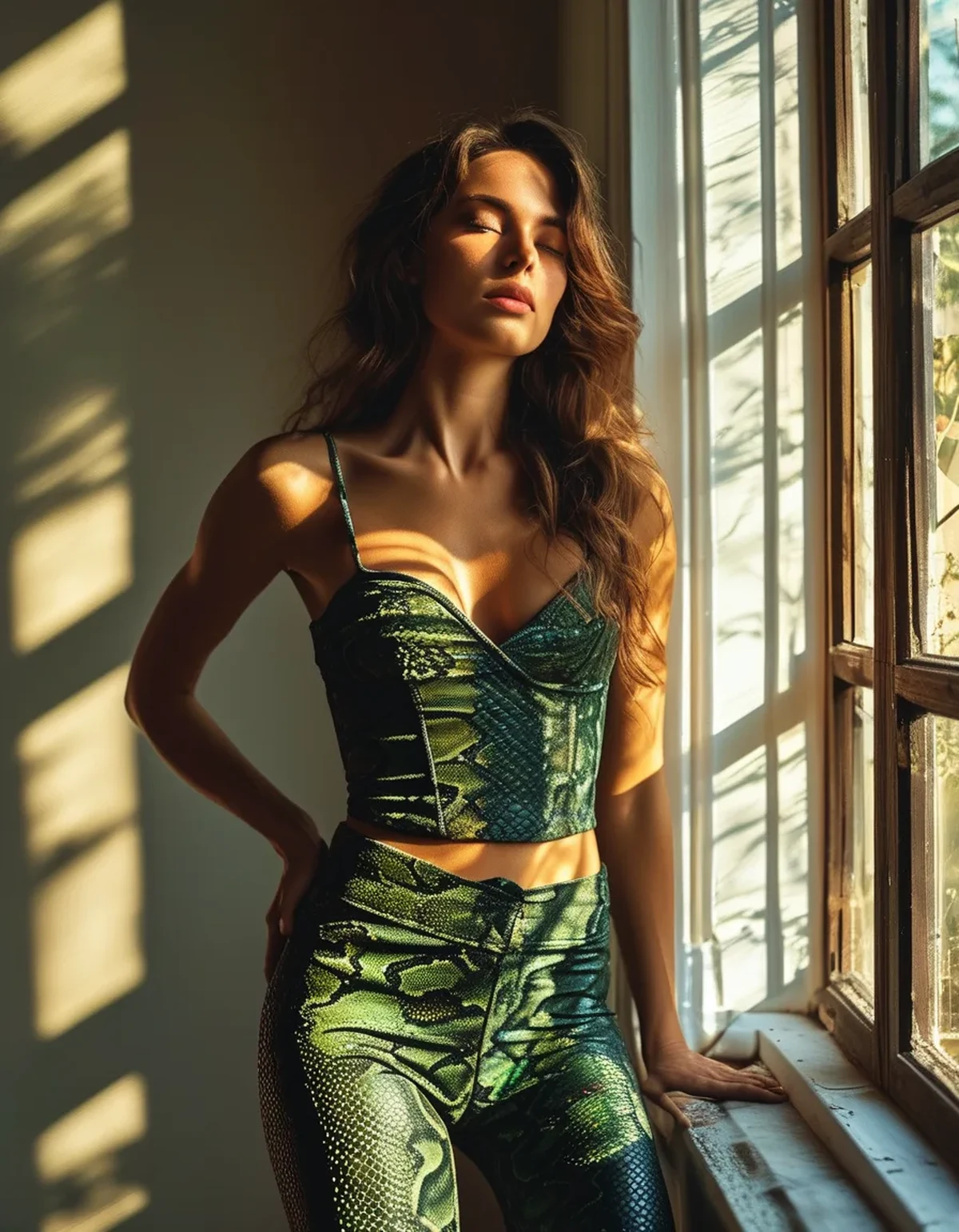
Because the pattern is topography, not pigment, it depends entirely on how light hits those peaks and valleys. Under direct, angled light — a low afternoon sun, a single overhead spotlight — the raised sections catch highlights and the pressed sections fall into shadow, so the scales or quilting look carved and three-dimensional. Under flat, diffuse light — an overcast sky, even fluorescent gym panels bouncing off white ceiling tiles — there’s no shadow differential to define the edges, so the same pattern reads as a faint tonal shift instead of a texture.
Fabric weight compounds this. A heavier, higher-denier knit holds an emboss deeper and longer because there’s more material for the roller to compress; the ridges stay pronounced through washing and stretching. A lighter, thinner knit takes a shallower emboss that reads great in a bright studio photo but relaxes out within a few wears, especially at stretch points like the back of the knee. If a listing doesn’t mention fabric weight (look for gsm, grams per square meter — 240+ is a safe floor for texture that lasts), assume it’s on the lighter, shallower end.
Why Do the Same Leggings Look Bolder in Photos Than in the Store — Or Vice Versa?
Camera flash and embossed texture have a complicated relationship, and it explains most of the “these don’t look like the photos” complaints. A direct, on-axis flash — the built-in flash on a phone, a ring light positioned straight at the subject — hits the raised parts of the emboss first and reflects almost straight back into the lens. That blows out the highlights on the pattern’s peaks, and if the fabric also has any sheen finish (common on snake and croc embossing to fake a “leather” look), the flash can wash out ten to twenty percent of the visible texture, making a deeply embossed pattern look like a subtle one.
Product photography avoids this by using off-axis, diffused lighting — softboxes positioned at 30-45 degree angles, sometimes with a secondary light just to define shadow in the pattern grooves. This is a legitimate way to show texture accurately, but some listings go further and use a raking light specifically angled to exaggerate every ridge, which oversells depth the fabric doesn’t have in normal wear.
Your gym is the opposite problem. Most gym lighting is overhead and diffuse by design, spread evenly across the ceiling to avoid glare on mirrors and machines. That flat, shadowless light is the worst-case scenario for reading emboss depth — it’s why a pattern that looked dramatic in a doorway or window selfie looks almost solid-color under gym panels. This isn’t a flaw in the leggings; it’s a predictable optical outcome you can plan around, especially if the visual pop of the pattern is part of why you bought them.
Myth vs Fact — What People Get Wrong About Embossed Texture
Myth: A more dramatic product photo means a more dramatic pattern in real life. Fact: A dramatic photo often just means more aggressive raking light or photo editing contrast, not deeper embossing. Two leggings with identical actual emboss depth can look completely different in listing photos depending on light angle alone. The photo tells you about the photographer’s setup as much as the product.
Myth: If the pattern looks faded after a few washes, the fabric is defective. Fact: Shallow embossing on lightweight knits relaxes with heat and mechanical stress — dryer heat especially will soften pressed ridges back toward flat over repeated cycles. This is expected fabric behavior, not damage, on anything under roughly 220 gsm. Air-drying preserves emboss depth substantially longer than machine drying.
Myth: Darker colors show embossed texture better. Fact: It’s the opposite in most lighting. Dark, saturated colors (black, navy, deep green) absorb more light overall, which means there’s less light available to create the highlight-shadow contrast that makes texture visible — you need stronger, more directional light to see the pattern clearly. Lighter and mid-tone colors (sand, sage, dusty rose) reflect more ambient light and show subtle texture even under flatter lighting, which is why a lot of the “surprisingly textured in person” reviews cluster around lighter colorways.
Myth: All “textured” leggings use the same process. Fact: Embossed (heat-pressed), jacquard-knit (woven texture built into the knit structure itself), and laser-cut (surface etching, usually on a bonded fabric) are three different techniques with different durability and light behavior. Jacquard texture is the most consistent across lighting because it’s structural, not surface-pressed — worth checking the fabric description for that word if consistency matters more to you than photo drama.
How Do You Actually Judge a Pattern From a Product Photo Before Buying?
Since you can’t touch the fabric before ordering, treat the product photos as evidence to cross-examine rather than take at face value. Look for a photo taken outdoors or near a window, not just the studio flat-lay — natural side light is the closest free approximation to how you’ll actually see the leggings day to day, and it’s much harder to fake than a raking studio light. If every photo in a listing is the same flat, evenly-lit studio shot, that’s itself information: the seller either doesn’t have varied lighting samples or is intentionally avoiding showing the pattern under less flattering conditions.
Zoom into the knee and thigh area specifically, since that’s where embossed patterns get stretched during wear and where shallow embossing shows the most fading first. If the zoomed photo shows crisp, defined edges even at high magnification, that’s a decent sign of deeper, more heat-set pressing.
Read the fabric composition for the process, not just the fiber content. “Emboss-printed” or just “printed” usually means pigment, which won’t have the dimensional feel you’re picturing. “Heat-embossed,” “3D texture knit,” or “jacquard” indicate an actual structural or pressed texture. When gsm or fabric weight is listed, treat anything under 200 gsm as likely to show pattern loss within a season of regular wear and washing.
Finally, check for a video or 360-degree view if the listing has one — even a slow-panned clip reveals more about how light moves across the texture than any number of static photos, since it shows the transition between highlight and shadow that a single frame can’t.
FAQ: Embossed Legging Lighting Questions, Answered
Will my embossed leggings look different in every room of my house?
Yes, to some degree — any change in light angle or intensity shifts how the shadow-and-highlight pattern reads, though the difference is usually subtle indoors and much more noticeable moving between indoor and outdoor light.
Does washing make embossed texture fade permanently?
On lower-gsm fabrics, yes, gradually — heat from the dryer is the main culprit. Cold wash and air- or low-heat dry to preserve emboss depth for significantly longer.
Is jacquard-knit texture better than heat-embossed?
Not strictly better, but more consistent across lighting and more durable through washing, since the texture is knit into the fabric structure rather than pressed onto the surface afterward. Heat-embossed pieces are typically cheaper and offer bolder, more graphic patterns when new.
Why do my leggings look almost solid-colored under gym lights specifically?
Gym lighting is intentionally flat and overhead to reduce glare on mirrors, which removes the directional shadow that embossed texture needs to read visually. It’s the single worst common lighting condition for texture visibility, not a sign anything is wrong with the fabric.
TL;DR:
- Embossed texture is pressed, not printed, so it depends on light angle and shadow to be visible at all
- Flat gym lighting minimizes texture; angled natural light and camera flash both exaggerate or wash it out unpredictably
- Heavier fabric (240+ gsm) holds emboss depth longer through washing and wear than lightweight knits
- Judge product photos by looking for window/outdoor shots, zoomed knee-area detail, and fabric-process wording like “heat-embossed” or “jacquard”
The pattern isn’t lying to you in either photo — it’s just telling you two true things about two different lighting conditions.
Keep Reading
This article is for general informational and styling purposes only. Fit, sizing, and product availability may vary.